
Homogeneous slabs
Constant films: one scatterer, one thickness, one roughness. No depth-dependent Mix or named profile fields. Two material styles — free tensor components vs material (OOC + \(\rho\) + \(\gamma\)) — and the uniaxial vs biaxial diagonal packing.
Shared preamble:
from refloxide.model import MaterialSLD, FreeUniTensor, Mix, ReflectModel
from refloxide.profiles import (
    Diffusion,
    SecondOrderTransition,
    DepthProfile,
    Spline,
    Polynomial,
    CallableField,
    CallableDepthProfile,
)

vac = MaterialSLD("", 0, name="vacuum")(0, 0)
si = MaterialSLD("Si", 2.33, name="si")(0, 3.0)
mat = FreeUniTensor(energies=[284.4], name="film")
mat_a = FreeUniTensor(energies=[284.4], name="a")
mat_b = FreeUniTensor(energies=[284.4], name="b")
mat_c = FreeUniTensor(energies=[284.4], name="c")
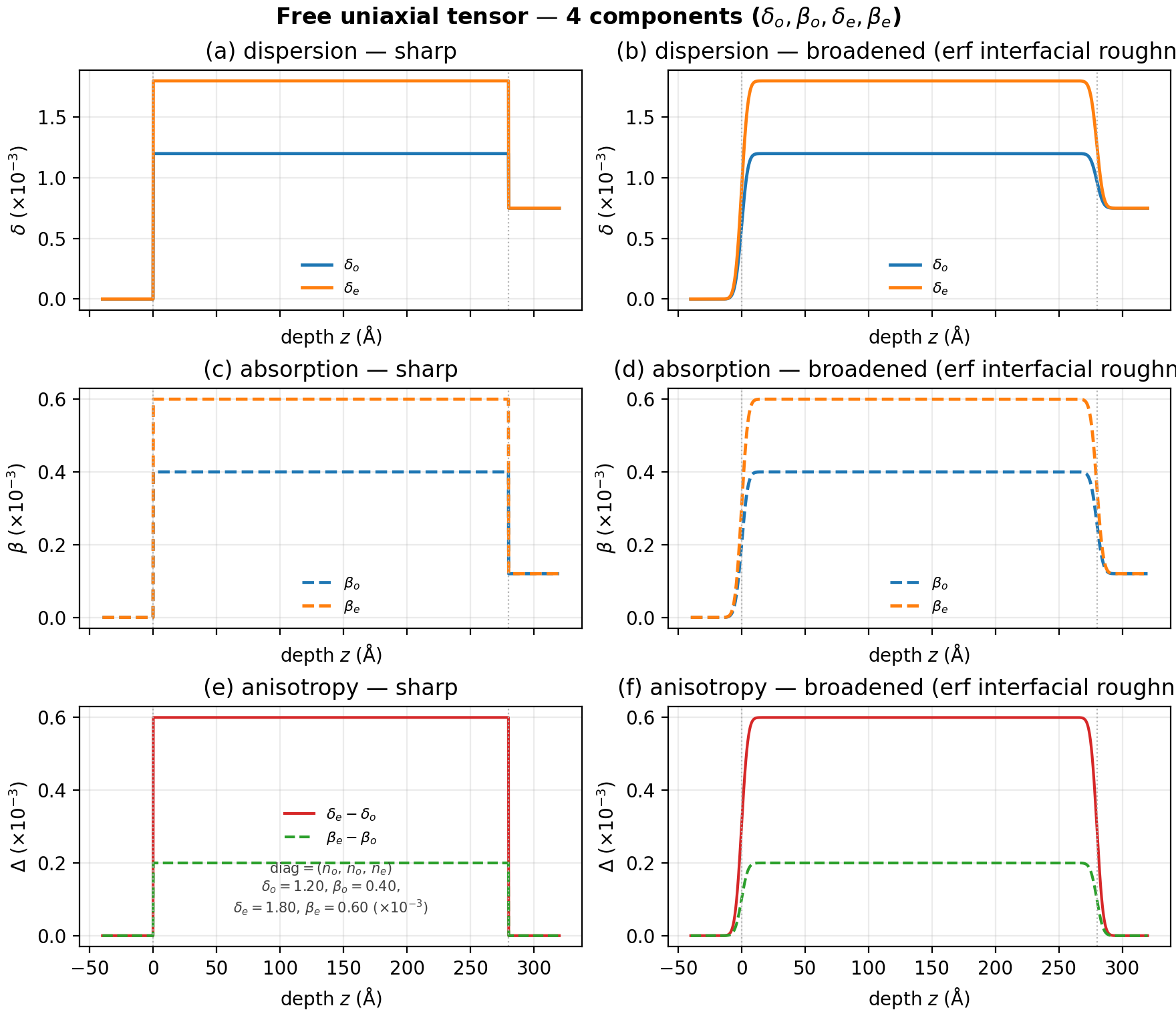
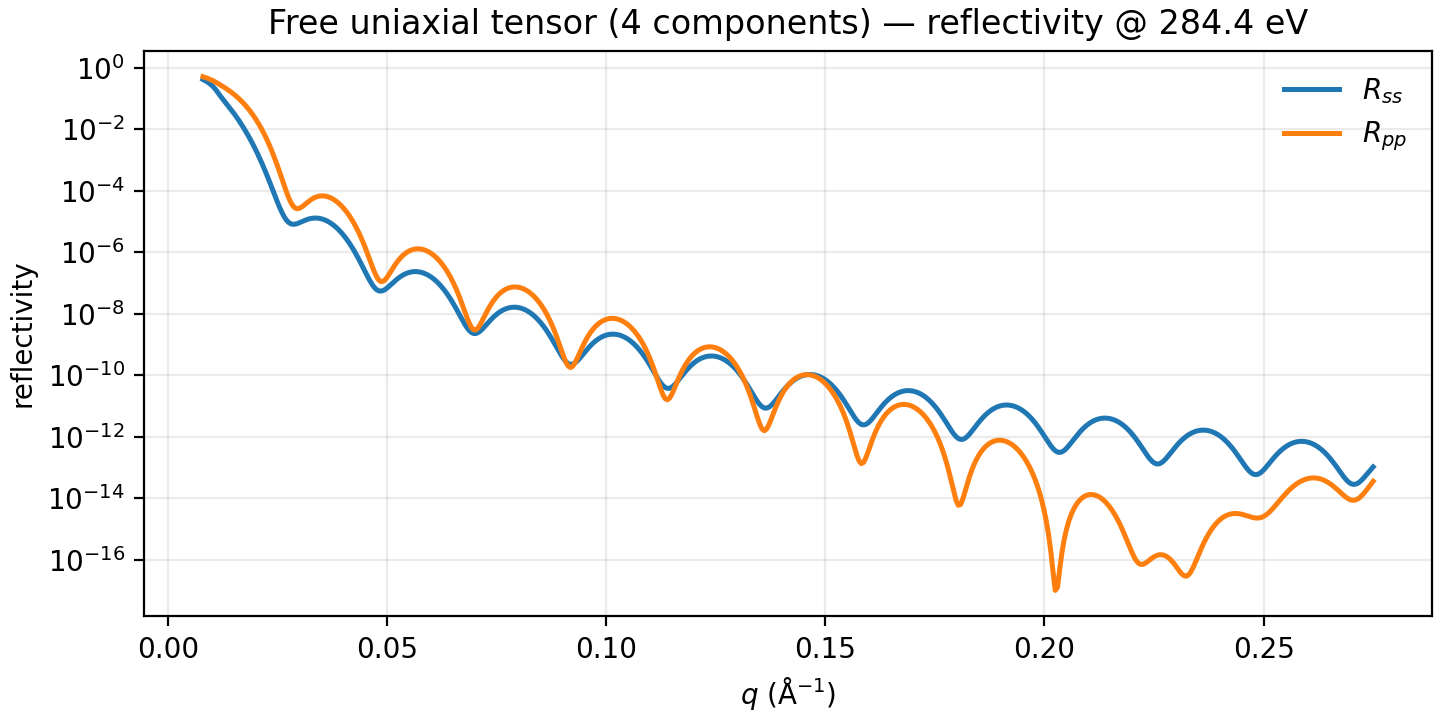
Free uniaxial tensor (4 components)
Builder: case_homogeneous_slab
FreeUniTensor / FreeTensorSLD exposes four independent parameters per
energy: \(\delta_o\), \(\beta_o\), \(\delta_e\), \(\beta_e\). The lab diagonal is
\((n_o,\,n_o,\,n_e)\) with \(n=\delta+i\beta\).
mat = FreeUniTensor(energies=[284.4], name="film")
ch = mat.channel_at(284.4)
ch.delta_o.setp(1.2e-3)
ch.beta_o.setp(4e-4)
ch.delta_e.setp(1.8e-3)
ch.beta_e.setp(6e-4)
stack = vac | mat(280.0, 2.0) | si
model = ReflectModel(stack, energies=[284.4], parallel=False)
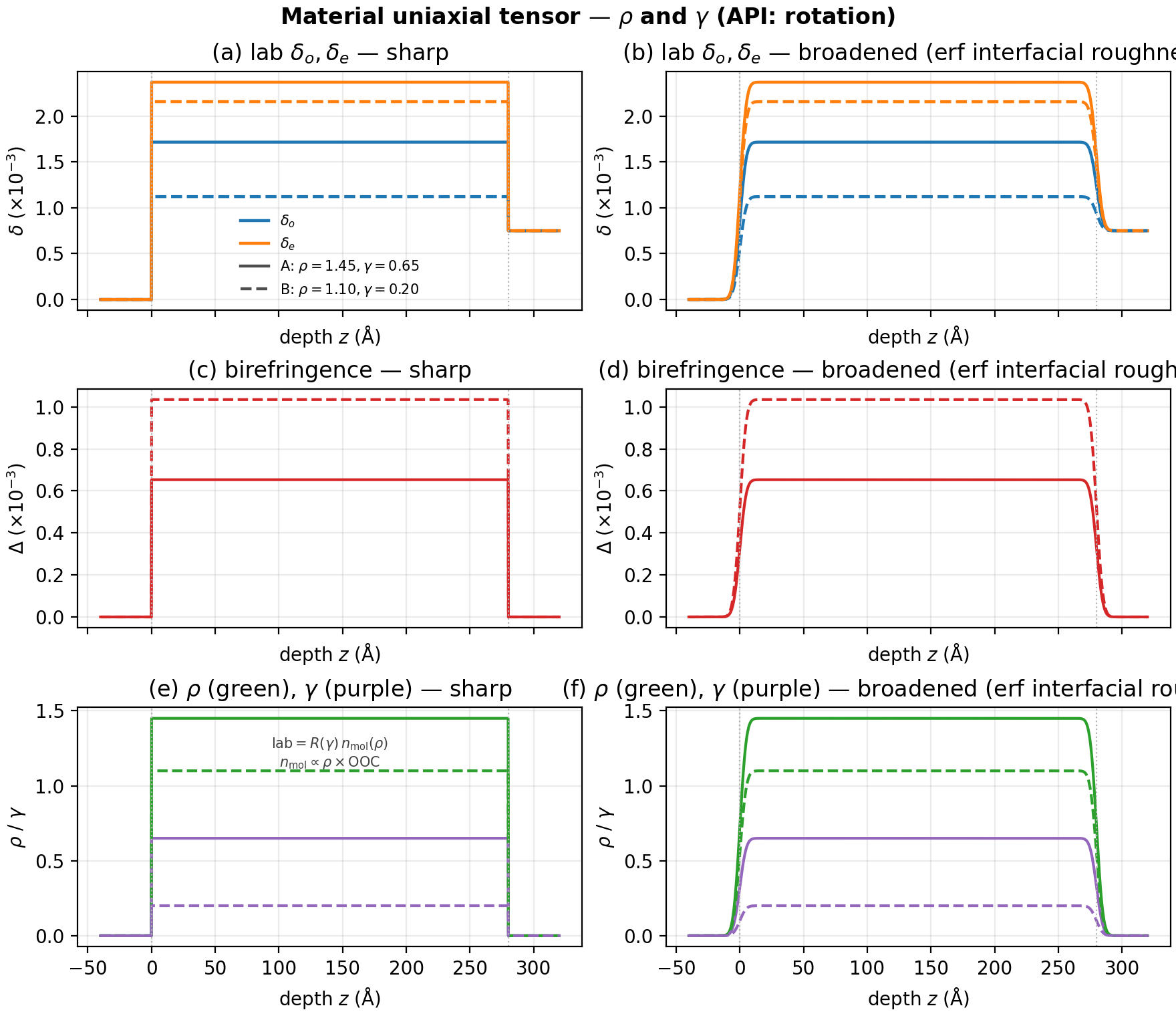
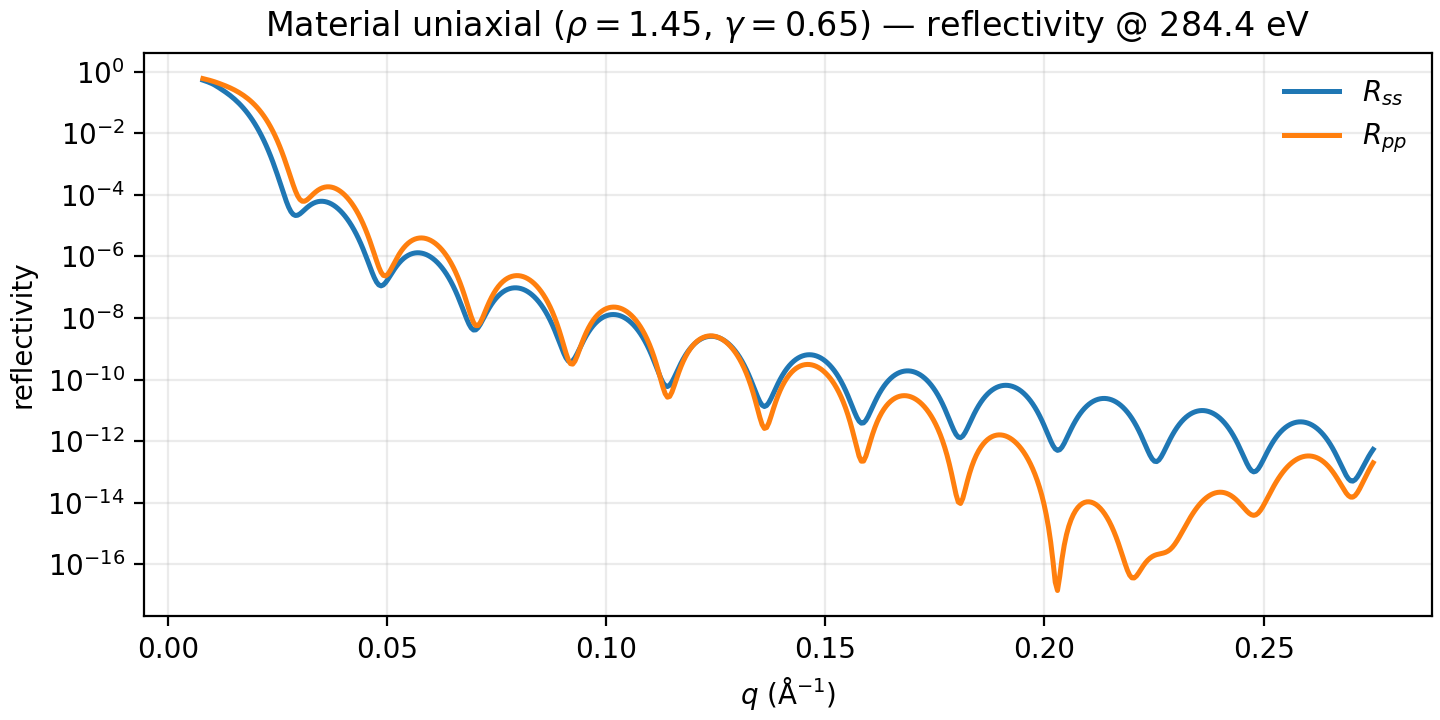
Material uniaxial tensor (\(\rho\), \(\gamma\))
Builder: case_homogeneous_material_tensor
UniTensorSLD loads molecular indices from an optical-constants table,
scales them by mass density \(\rho\), and rotates into the lab frame with
polar angle \(\gamma\) (API name: rotation). Depth figure contrasts two
\((\rho,\gamma)\) pairs on the same OOC.
from refloxide.data import OpticalConstants
from refloxide.model import UniTensorSLD
import polars as pl
import numpy as np

ooc = OpticalConstants.from_source(
    pl.DataFrame(
        {
            "energy": np.linspace(250.0, 320.0, 20),
            "n_xx": np.full(20, 1.0e-3),
            "n_ixx": np.full(20, 3.0e-4),
            "n_zz": np.full(20, 2.0e-3),
            "n_izz": np.full(20, 6.0e-4),
        }
    )
)
film = UniTensorSLD(ooc, density=1.45, rotation=0.65, name="film")
stack = vac | film(280.0, 2.0) | si
model = ReflectModel(stack, energies=[284.4], parallel=False)
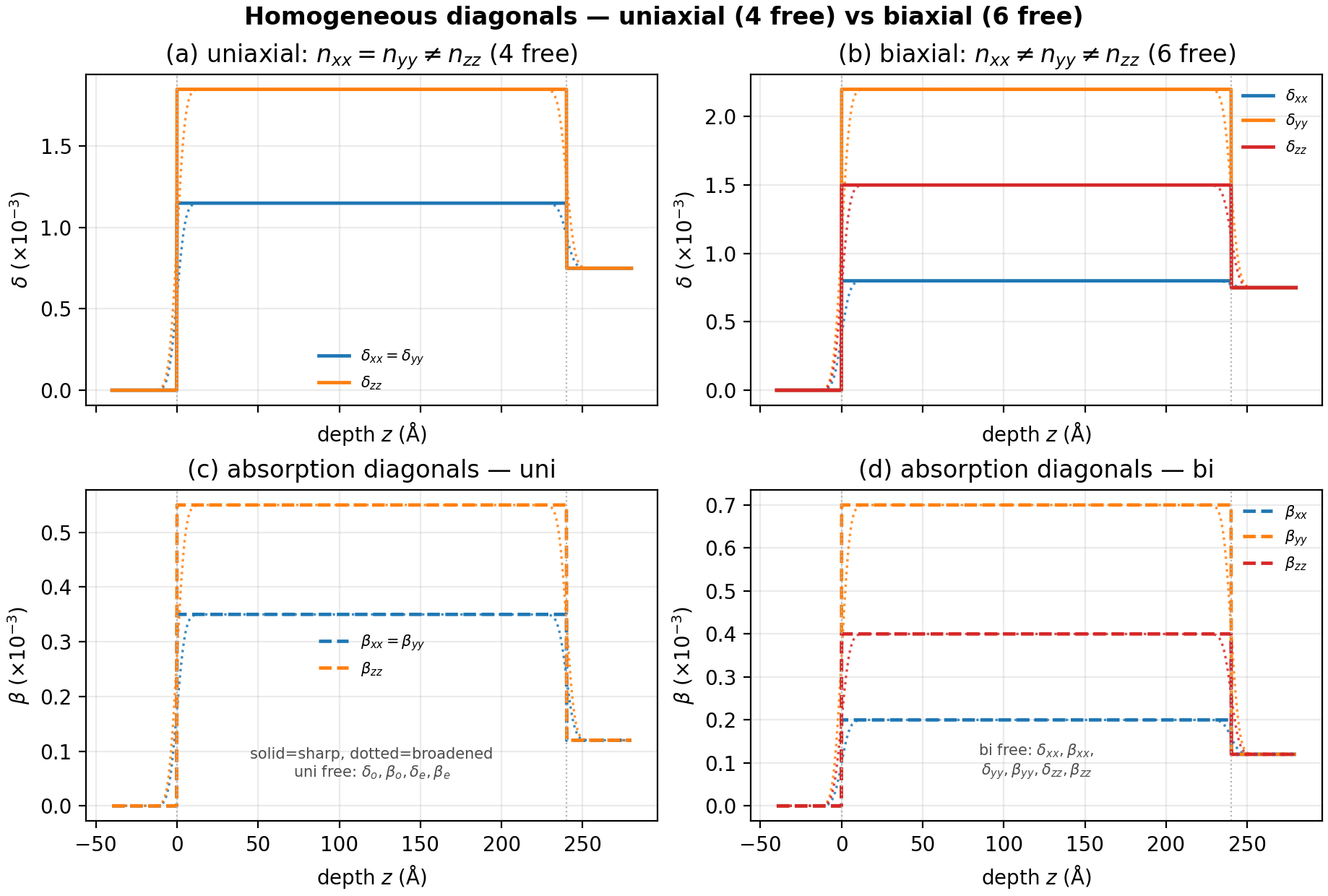
Uniaxial vs biaxial diagonals
Builder: case_homogeneous_uni_vs_bi
Uniaxial packing constrains \(n_{xx}=n_{yy}\) (four free real scalars:
\(\delta_o,\beta_o,\delta_e,\beta_e\)). Biaxial frees \(n_{yy}\) as well (six
free scalars: \(\delta_{xx},\beta_{xx},\delta_{yy},\beta_{yy},\delta_{zz},\beta_{zz}\)).
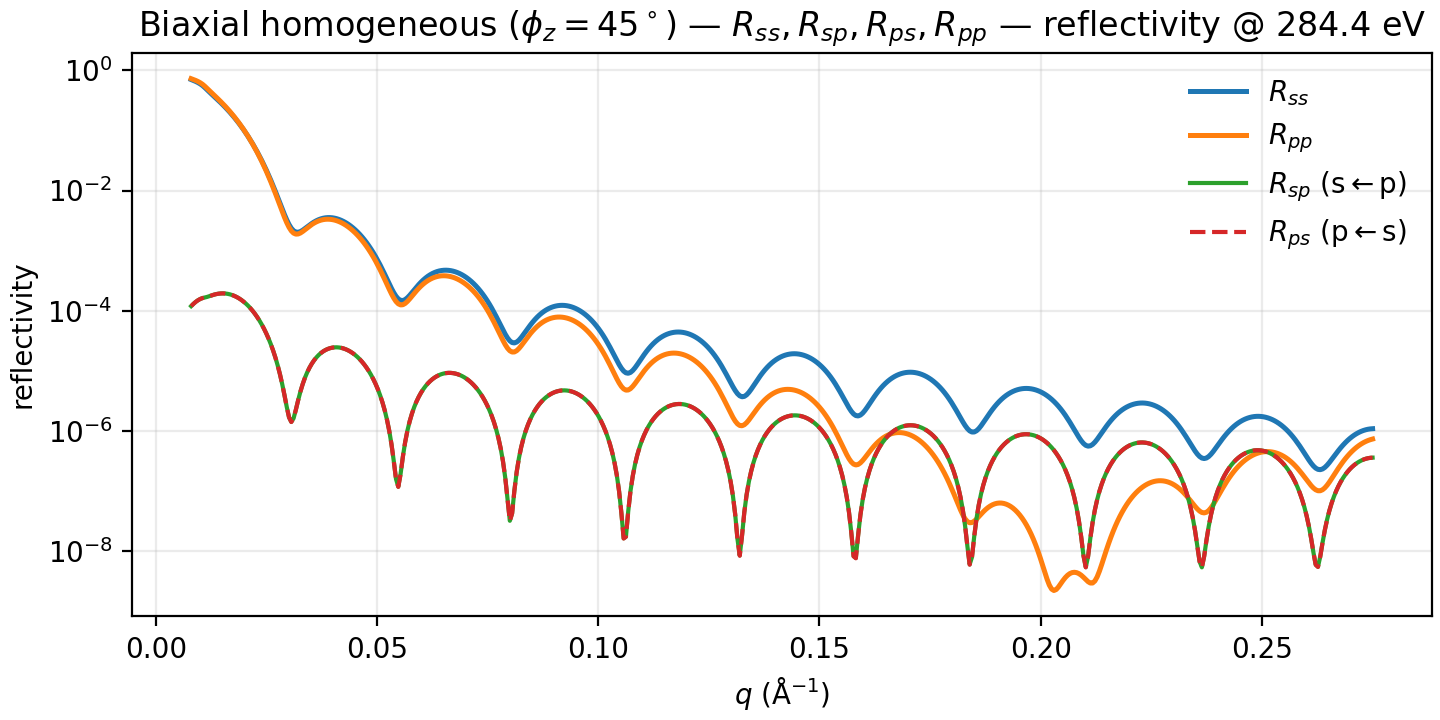
Depth figure shows the principal diagonal \(\delta\) and \(\beta\) channels.
Reflectivity uses general_reflectivity on the same film after a \(45^\circ\)
in-plane rotation (lab-frame diagonal biaxial keeps \(R_{sp}=R_{ps}=0\) under
\(xz\) incidence) and plots \(R_{ss}\), \(R_{sp}\), \(R_{ps}\), \(R_{pp}\).
Kernel packing is \([[R_{pp}, R_{sp}], [R_{ps}, R_{ss}]]\) with
\(R_{sp}\) = s reflected from p incident (refl[:, 0, 1]) and
\(R_{ps}\) = p reflected from s incident (refl[:, 1, 0]).
import numpy as np
from refloxide.tmm import general_reflectivity

n_xx = 0.80e-3 + 2.0e-4j
n_yy = 2.20e-3 + 7.0e-4j
n_zz = 1.50e-3 + 4.0e-4j
t = 240.0

def diag(nx, ny, nz):
    m = np.zeros((3, 3), dtype=np.complex128)
    m[0, 0], m[1, 1], m[2, 2] = nx, ny, nz
    return m

phi = np.deg2rad(45.0)
c, s = np.cos(phi), np.sin(phi)
rot_z = np.array([[c, -s, 0.0], [s, c, 0.0], [0.0, 0.0, 1.0]])
t_lab = rot_z @ diag(n_xx, n_yy, n_zz) @ rot_z.T
layers = np.array(
    [
        [0.0, 0.0, 0.0, 0.0],
        [t, 0.5 * (t_lab[0, 0].real + t_lab[1, 1].real),
         0.5 * (t_lab[0, 0].imag + t_lab[1, 1].imag), 2.0],
        [0.0, 7.5e-4, 1.2e-4, 3.0],
    ],
    dtype=np.float64,
)
tensor = np.stack(
    [
        diag(0j, 0j, 0j),
        t_lab,
        diag(7.5e-4 + 1.2e-4j, 7.5e-4 + 1.2e-4j, 7.5e-4 + 1.2e-4j),
    ]
)
q = np.linspace(0.008, 0.275, 520)
refl = general_reflectivity(q, layers, tensor, 284.4, parallel=False)
# [[R_pp, R_sp], [R_ps, R_ss]]: R_sp = s<-p, R_ps = p<-s
r_pp, r_sp = refl[:, 0, 0], refl[:, 0, 1]
r_ps, r_ss = refl[:, 1, 0], refl[:, 1, 1]